


When you apply for a loan at a traditional bank, they check your credit score, your income, and your assets. But what happens when someone has none of those things? That's exactly the problem microfinance institutions (MFIs) solve — and how they evaluate borrowers is more thoughtful than most people realize.
The Problem With Traditional Credit Scoring
Credit scores were designed for people who already have financial history — a credit card, a mortgage, a car loan. For the 1.7 billion people worldwide who are unbanked, that history simply doesn't exist. A farmer in rural Kenya or a street vendor in Bangladesh isn't a bad borrower. They're just an invisible one, as far as traditional banks are concerned.
MFIs had to build a completely different system from scratch.
What MFIs Look At Instead
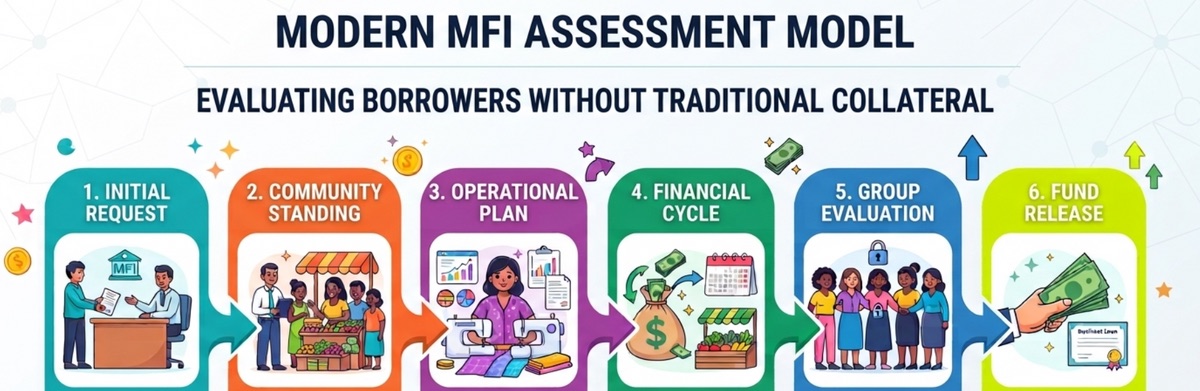
1. Character Over Collateral
The first thing most MFIs assess is character — not in a vague way, but through direct interviews and community references. Loan officers often visit borrowers at their homes or businesses before approving anything. They want to understand how long someone has lived in the community, what their reputation is, and whether neighbors would vouch for them.
This sounds informal. It's actually highly predictive. People who are embedded in a community have more to lose if they default — their social standing, their relationships, their ability to borrow again.
2. Business Viability
MFIs look at whether the borrower has a realistic plan for the money. A woman who wants to buy two more sewing machines to fill existing orders is a different risk than someone with a vague plan to "start a business." Loan officers are trained to ask specific questions: Who are your customers? What does one week of revenue look like? What happens if sales drop?
3. Cash Flow, Not Income
Traditional banks want to see a salary. MFIs care about cash flow — money that actually moves in and out of a business on a weekly or monthly basis. A food vendor might not have a "salary," but she can show that she consistently makes $40 on market days and has been doing so for two years. That consistency matters more than a formal income statement.
4. Group Lending Model
Many MFIs use a group lending structure where 5 to 10 borrowers form a group and vouch for each other. If one person defaults, the rest are responsible — and the entire group loses access to future loans. This creates a built-in accountability system that banks don't have. Borrowers vet each other before joining a group, which means the screening happens before the loan officer even gets involved.
How Loan Sizes Are Determined
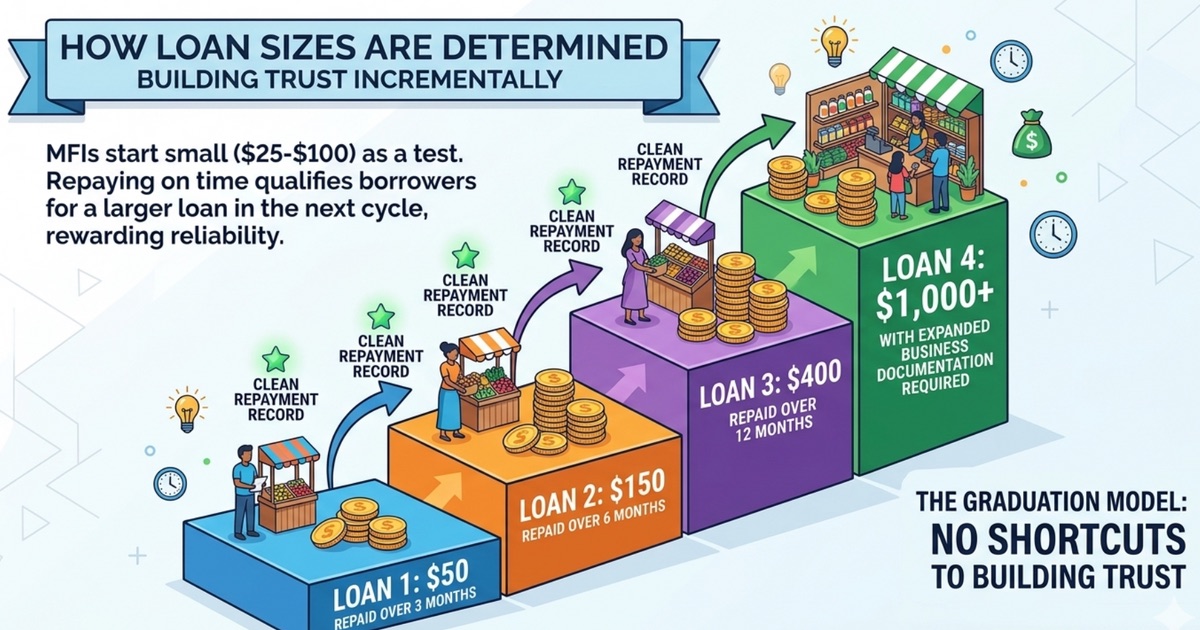
MFIs almost always start small — sometimes as little as $25 to $100. This isn't arbitrary. A small first loan is a test. If the borrower repays on time, they qualify for a larger loan next cycle. This graduation model rewards reliability and builds trust incrementally.
A typical loan ladder might look like this:
Loan 1: $50 — repaid over 3 months
Loan 2: $150 — repaid over 6 months
Loan 3: $400 — repaid over 12 months
Loan 4: $1,000+ — with expanded business documentation
Each step up requires a clean repayment record. There are no shortcuts.
How AI Is Changing This
In markets where mobile money is common — Kenya, Bangladesh, India — MFIs are increasingly using transaction history from mobile payment apps to supplement their assessments. An AI model might analyze 18 months of mobile payment data to predict repayment likelihood with more accuracy than a human interview alone.
This doesn't replace the human judgment. It adds a layer of data that didn't exist before. The result is faster approvals, lower default rates, and access for borrowers who might have been turned away simply because a loan officer couldn't visit their village.
Why This Matters
The way MFIs evaluate borrowers reflects something important: financial trustworthiness is not the same as financial history. Millions of people around the world are reliable, resourceful, and creditworthy — they just never had a system that could see that. Microfinance built one.
Understanding how loan decisions get made is useful whether you're planning to work in this field, start a chapter, or simply think more critically about how money and access intersect in the real world.