

Microfinance education in schools builds a powerful ecosystem that drives global change. When students learn the principles of microfinance, they do not just read about economics—they actively unlock opportunities for unbanked communities worldwide.
By introducing microfinance into school curriculums or starting a student-led club, educational institutions connect classrooms directly with Microfinance Institutions (MFIs) and Non-Profit Organizations (NPOs).
The Microfinance Impact Cycle
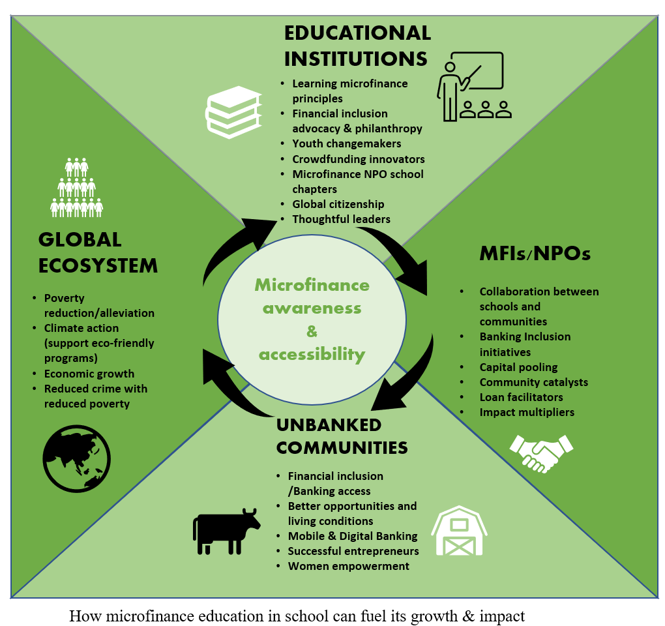
The infographic below illustrates how school-based microfinance initiatives feed into a continuous cycle of global growth:
Key Pillars of a School Microfinance Program
1. Educational Institutions (The Launchpad)
Schools serve as the perfect incubation space for youth changemakers. Inside a microfinance club or classroom, students learn how small loans can change lives. They become thoughtful leaders, master crowdfunding tools, and set up official non-profit school chapters to raise real capital.
2. MFIs and NPOs (The Bridge)
Student clubs do not work in isolation. They collaborate directly with established field partners. By pooling fundraising capital, students act as impact multipliers, helping local loan facilitators reach people who need financial backing the most.
3. Unbanked Communities (The Ground Impact)
The ultimate goal is driving financial inclusion. The capital and awareness generated by students provide mobile and digital banking access to remote areas. This creates successful local entrepreneurs, improves daily living conditions, and directly drives women's empowerment.
4. The Global Ecosystem (The Big Picture)
When unbanked communities thrive, the entire world benefits. Local economic growth reduces poverty, which naturally lowers crime rates. Furthermore, microfinance programs frequently target eco-friendly initiatives, funding local climate action alongside financial stability.
Student Voice: Why This Matters to Us
"We always hear about global poverty in history class, but it usually feels like a problem too massive for us to fix. Joining the microfinance club changed that completely. We aren't just sending charity; we are funding a cow for a family farm or helping a woman start a weaving business. We track the micro-loans, see the money get repaid, and watch communities lift themselves up. It taught us that regular students can actually shift the global economy."
Bringing Microfinance to Your School
Starting a microfinance movement on your campus is straightforward:
Add it to the syllabus: Blend microfinance case studies into existing economics, business, or social studies classes.
Launch a club chapter: Establish a dedicated student group focused on crowdfunding and awareness campaigns.
Partner up: Connect with local or international MFIs to give students direct access to verified lending platforms.
By bridging the gap between student drive and global financial tools like Kiva, schools can systematically dismantle poverty—one micro
loan at a time.